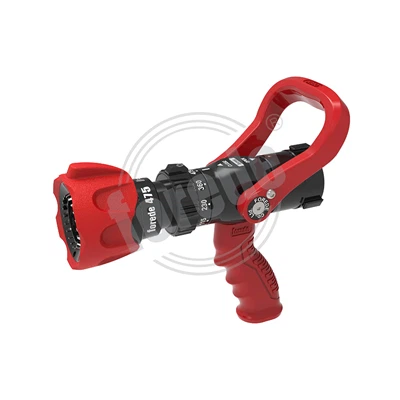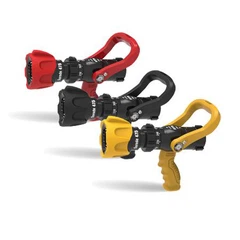

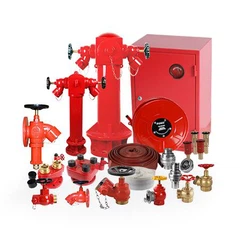

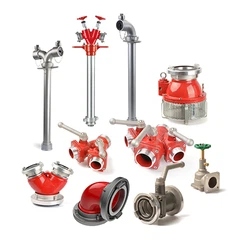
Hose nozzles are wide used in fire fighting, and many people have the question: Are hose nozzles universal?
Nozzle types
In 1964 the National Fire Protection Association (NFPA) created a set of standards outlining performance requirements for nozzles used in fire suppression. These standards were updated in 2018. The revised standards divide hose nozzles into four categories: basic, constant gallonage, constant pressure, and constant/select gallonage.

Basic
Basic nozzles are fire hose nozzles with an adjustable-pattern spray. The rated discharge is delivered at a designated nozzle pressure and setting. The gallons per minute (GPM) and PSI of the nozzle vary as the stream shifts from straight to fog.
Constant Gallonage
Constant gallonage nozzles are also adjustable-pattern spray nozzles. However, they discharge at a constant rate through a range of patterns, straight to wide, at a designated pressure. As the nozzle pattern changes, the orifice size remains the same to maintain a fairly constant GPM.
Constant Pressure
Also called automatic, constant pressure nozzles are self-explanatory. The pressure on these nozzles remains relatively constant through a range of discharge rates. The spray pattern is adjustable, and the operator can choose from one of several different orifice sizes. This nozzle style helps guarantee stream reach with a self-adjusting component to keep the pressure steady.
Constant/Select Gallonage
Constant/select gallonage nozzles have a constant discharge rate which allows for manual adjustment to effect a predetermined discharge rate while the nozzle is flowing.
Thread & coupling
Another thing to consider when selecting a fire hose nozzle is the threads. Threads are what connect the nozzle to the hose. All nozzles have threads, but not all threads are the same. Therefore, users must consider the compatibility between nozzles and hoses. The main thread types for fire hose nozzles are National Standard Thread (NST), National Pipe Straight Hose (NPSH), and National Pipe Thread (NPT).
NST threads, also called National Hose (NH) threads, are the most widely used fire thread standard in the U.S. NPSH threads have the same threads per inch as NPT, but the threads do not taper. NST and NPSH are both straight threads, but they are not compatible. Having hoses and nozzles with different, incompatible threads creates a dire situation, putting lives and property at risk.

NH
National Hose thread (NH), also known as National Standard Thread (NST). It is the most common type of fire hose coupling used in the United States. The male and female straight (non-tapered) threads screw together and the connection is sealed with a gasket.
British instantaneous coupling
Also called John Morris Coupling, BS336 Instantaneous fire couplings are similar in design to the camlock fittings, and are used by; UK, Irish, New Zealand, Indian & Hong Kong fire brigades.
Machino
A Japanese quick connect and disconnect coupling used on fire hoses in Japan and defined by JIS B9911
Gost
A sexless coupling, a.k.a. Bogdan coupler,[21] used on fire hoses in Russia and defined by GOST R 53279-2009, available in several sizes, including DN 25, DN 40, DN 50, DN 65, DN 70, DN 80, DN 100, DN 125, and DN 150.
Storz
A Storz coupling is a quarter-turn or sexless coupling, commonly used to connect to fire hydrants. It is easy to connect, has no particular male or female end, and lugs are on the inside of the joint. This is the standard coupling on fire hoses in Denmark, Germany, Austria, Poland, Switzerland, Sweden, the Netherlands and Greece.[26] It is also widely used in Australia. It can be manufactured by casting for general hose connection and low pressure applications, but for firefighting, it is better to use forgings to guarantee the safety and durability of the coupling.
Conclusion
Fire hose nozzles are an essential tool for combating fires in any emergency situation. They are designed to provide a controlled water flow that helps extinguish flames and protect lives and property. One common question people ask is if fire hose nozzles are universal. The answer is that most fire hose nozzles are standardized and allow for compatibility between hoses regardless of their brand or manufacturer. This means that firefighters can use different hoses and nozzles together without any issues. Standardization has been achieved through strict adherence to industry standards and protocols, which have been developed over time. These standards ensure that fire hose nozzles are reliable, durable, and efficient. They also help improve safety by minimizing the risk of equipment failure and maximizing the effectiveness of firefighting efforts. While there may be some variations in design and functionality between different fire hose nozzles, they are generally interchangeable and provide the same high level of performance. Most firefighter training programs cover the proper use of fire hose nozzles and provide instructions on how to select the right nozzle for a given situation.
Contacct Us