
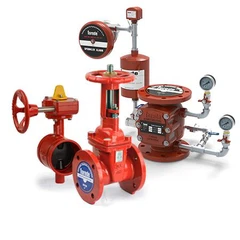

The pressure reducing valve is a pressure regulating device, its main function is to reduce the high pressure fluid to a low pressure state to ensure the normal operation of the system. The working principle of the pressure reducing valve is very simple. It sets a pressure difference and reduces the fluid to the set pressure range when it passes through the pressure reducing valve.
The main components of the pressure reducing valve are the valve body, valve core and spring. When high-pressure fluid enters the pressure reducing valve, the pressure force will make the valve core rise, and the spring will also be under the action of pressure, causing the valve core to move down. When the force between the spool and the spring is balanced, the pressure reducing valve works stably within the set pressure range.
The advantage of the pressure reducing valve is not only that it can reduce the pressure of high-pressure fluid, but also that it can stably maintain the set pressure range. In this way, the normal operation of the system can be guaranteed, and damage and failure caused by pressure changes can be avoided at the same time.
In practical applications, pressure reducing valves have other advantages. For example, it can effectively control the flow rate and prevent the fluid from being too fast or too slow, thus ensuring the stability and safety of the system. The pressure reducing valve can also reduce the energy consumption of the system and reduce the waste of energy, which is very important for environmental protection and energy saving.
Pressure reducing valves have a wide range of applications, and they are widely used in various industrial production and water supply systems. For example, in petrochemical, electric power, pharmaceutical and food industries, pressure reducing valves are used to control flow and pressure, so as to ensure the safety and stability of production. In the urban water supply system, the pressure reducing valve is used to control the water supply pressure, so as to ensure the stability and safety of the water source.