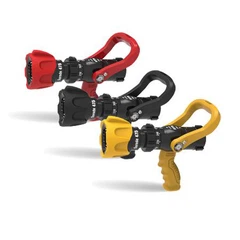


Air-Aspirating Foam Nozzle

What is a Handheld Air-Aspirating Foam Nozzle?
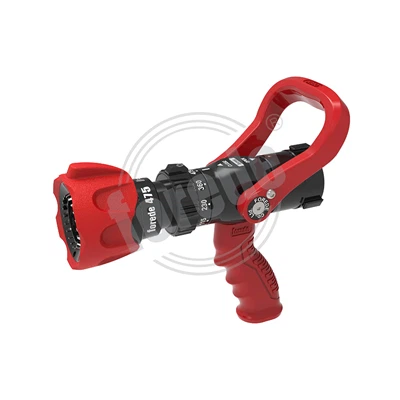
Air-aspirating foam nozzle (AAF nozzle) is a portable firefighting device designed to generate high-quality fire-suppressing foam by mixing water, foam concentrate, and ambient air. Unlike fixed systems, handheld AAF nozzles are manually operated, offering firefighters flexibility in directing foam streams during emergencies. These nozzles are essential for combating Class A (solid combustibles) and Class B (flammable liquids) fires in dynamic environments.
Key Components
Nozzle Body: Typically made of lightweight, corrosion-resistant materials like aluminum alloy or reinforced polymers.
Venturi Mechanism: A constricted tube that accelerates water-foam solution flow, creating a vacuum to aspirate air.
Adjustable Flow Control: Allows users to switch between straight stream (water) and foam application modes.
Foam Tube: Where air and foam solution mix to generate expanded foam.
Grip Handle: Ergonomically designed for ease of use during prolonged operation.
How It Works
1.1 Foam Solution Delivery: A pre-mixed foam solution (water + foam concentrate) is supplied via a fire hose connected to the nozzle.
1.2 Air Aspiration: As the solution flows through the venturi, it creates suction, drawing in ambient air through intake ports.
1.3 Foam Generation: Air and foam solution combine in the mixing chamber, producing low- to medium-expansion foam (5:1 to 200:1 expansion ratio).
1.4 Foam Application: The expanded foam is discharged as a cohesive blanket to smother flames and suppress flammable vapors.
Advantages of Handheld Air-Aspirating Foam Nozzles
2.1 High-Quality Foam Generation
Produces stable, uniform foam with small, tightly packed bubbles, ensuring optimal coverage and adhesion to fuel surfaces.
Achieves expansion ratios of 8:1 to 20:1 (low-expansion) for direct fire attack or 50:1 to 200:1 (medium-expansion) for vapor sealing.
2.2 Portability and Flexibility
Lightweight design (typically 2–5 kg / 4.4–11 lbs) enables rapid deployment in confined spaces or mobile firefighting scenarios.
2.3 Fuel-Specific Suppression
Hydrocarbon Fires: Aqueous Film-Forming Foam (AFFF) creates a vapor-sealing aqueous film.
Polar Solvent Fires: Alcohol-Resistant AFFF (AR-AFFF) forms a polymeric membrane resistant to fuel dissolution.
2.4 Reduced Foam Concentrate Consumption
Efficient air aspiration minimizes foam concentrate usage while maximizing foam volume (e.g., 3% AFFF at 200 L/min generates 6,000–40,000 L of foam).
2.5 Durability and Safety
Rugged construction withstands high-pressure (up to 12 bar / 175 psi) and extreme temperatures (–20°C to 60°C).
Heat-resistant handles protect users from thermal feedback during close-range firefighting.
How to Use a Handheld Air-Aspirating Foam Nozzle
3.1 Pre-Operation Setup
System Connection:1. Attach the nozzle to a fire hose supplied by a foam proportioning system (e.g., inline inductor, CAFS). 2. Confirm the foam concentrate type and mixing ratio (e.g., 1%, 3%, or 6%).
Pressure Calibration:1.Adjust the water supply pressure to meet the nozzle's operating range (typically 4–10 bar / 60–145 psi).2. Refer to the nozzle's performance chart for flow rates (e.g., 100–600 L/min).
3.2 Operational Techniques
Foam Application Modes: 1.Roll-On Method: Direct the foam stream at the base of the fire, allowing the blanket to spread across the fuel surface.2.Raindown Method: Apply foam from above to gently cover the fire without disturbing the fuel (ideal for spills).3.Bank-In Method: Bounce foam off a wall or object to indirectly coat the fire (useful in obstructed spaces).
Distance and Angle:1. Maintain a 3–5 meter (10–16 ft) distance for optimal foam coverage.2.Hold the nozzle at a 30°–45° angle to maximize foam adhesion.
Switching Modes:Use the selector ring to switch between foam and water-only modes for cooling adjacent structures.
3.3 Post-Operation Maintenance
Rinse Thoroughly: Flush the nozzle with clean water to remove foam residue and prevent clogging.
Inspect for Damage: Check air inlet ports for debris and ensure the venturi tube is unobstructed.
Storage: Store in a dry, ventilated area to prevent corrosion or rubber component degradation.
As a leading company in firefighting field,FOREDE has a wide product range including Fire Nozzle&Monitors, Fire Sprinkler Systems, Foam Systems, Fire Hydrant Systems,Fire Truck Accessories.etc.
Our address
Nan'an City, Quanzhou City Fujian PRC-China
Phone Number