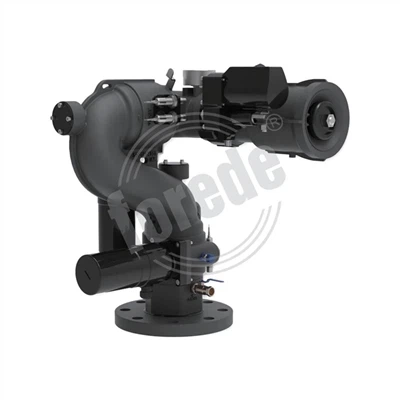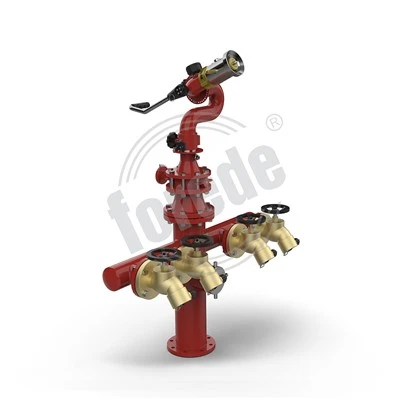


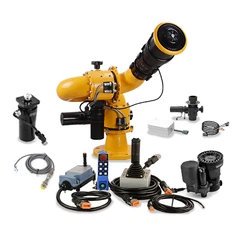
Manual fire monitor (also called a fire water monitor, fire cannon, or manual control monitor)A manual fire monitor, commonly referred to as a manual fire water cannon or simply a fire monitor, is a specialized firefighting device engineered to project high-velocity streams of extinguishing agents-primarily water or foam solutions-at significant flow rates and distances to control and extinguish large fires. Unlike standard fire hoses that rely on direct manual handling by firefighters, manual fire monitors are mounted on fixed bases, vehicles, or portable platforms and feature mechanical adjustment mechanisms that enable precise aiming through rotational and elevational movements controlled by handwheels, levers, or cranks.
The fundamental distinction of manual fire monitors lies in their operational control mechanism: all aiming, pattern adjustment, and flow regulation functions are executed through physical human interaction rather than electrical, hydraulic, or pneumatic automation. This manual operation provides inherent reliability, simplicity, and independence from external power sources, making these devices particularly valuable in emergency situations where power failures or system disruptions may compromise automated equipment.

Historical Evolution
The origins of manual fire monitors can be traced to the early 19th century when industrialization created larger-scale fire risks that exceeded the capabilities of traditional hand-held hoses and buckets. The first recognizable fire monitors emerged in the 1850s as fixed water cannons installed in factories, warehouses, and port facilities to address the growing threat of industrial fires. These early devices were constructed from cast iron, featured limited movement ranges, and required significant physical strength to operate, typically employing simple lever mechanisms for horizontal and vertical adjustment.
Fire monitor design reach a substantial advancements, coinciding with the development of modern fire protection principles and materials technology. The introduction of aluminum alloys in the 1920s revolutionized fire monitor construction, significantly reducing weight while maintaining structural integrity. During this period, standardized flange connections, improved bearing systems, and more sophisticated nozzle designs enhanced performance and reliability.
The mid-20th century marked the standardization of manual fire monitor specifications, with national and international bodies establishing performance criteria, testing methods, and safety requirements. The post-WWII industrial boom drove demand for more capable firefighting equipment, leading to the development of higher-flow, longer-range models specifically engineered for petrochemical facilities, tank farms, and marine environments.
despite the emergence of electrically operated, remote-controlled, and automatic fire monitors, manual variants retained their market prominence due to their reliability, cost-effectiveness, and simplicity. Modern manual fire monitors incorporate advanced materials such as hard-anodized aluminum alloys, stainless steel components, and high-performance polymers, alongside precision-engineered gear systems and ergonomic controls that significantly reduce operator exertion.

Classification by Control Mechanism
Handwheel Monitors
Standard design with independent handwheels for horizontal and vertical control.
Most common configuration offering precise positioning.


Lever-Operated Monitors
Feature control levers instead of handwheels for faster adjustment.
Common on portable and vehicle-mounted units.
Crank-Operated Monitors
Utilize crank handles for increased mechanical advantage.
Found on larger, higher-flow units requiring greater force.

Key Advantages
Manual fire monitors offer distinct advantages over automatic or electric models, especially in industrial and high-risk environments. Their core strengths lie in reliability, simplicity, cost-effectiveness, and robust performance.
Unmatched Reliability & Fail-Safe Operation
No Power Required: Operates purely mechanically via handles/wheels, independent of electricity, compressed air, or control systems. Functions perfectly during power outages or after system failures.
Resistant to Harsh Conditions: Simple mechanical structure withstands extreme temperatures (-30°C to +60°C), corrosion, vibration, and physical impact better than complex electronic systems.
No Malfunctions: Immune to software glitches, sensor errors, or communication failures that plague automatic monitors.
Simple, Intuitive, and Flexible Operation
Easy to Use: Ergonomic handles or handwheels allow for precise, one-person control. Minimal training is needed for operation.
Full Range of Motion: Typically features 360° horizontal rotation and wide vertical pitching (-45° to +90°) for complete coverage.
Instant Response: Operators can immediately adjust aim, flow rate, and spray pattern to adapt to dynamic fire conditions, such as changing flame direction or hotspots.
Secure Locking: Mechanisms to lock the monitor in place, allowing operators to set it and evacuate to safety.
Low Maintenance & Cost Efficiency
Easy Maintenance: Fewer moving parts mean less wear, fewer breakdowns, and simple routine checks (cleaning, lubrication).
Lower Upfront Cost: Significantly less expensive than electric, automatic, or intelligent fire monitors.
Minimal Lifecycle Cost: No costly electronics, circuit boards, or sensors to replace or calibrate.
Powerful Firefighting Performance
High Flow & Long Range: Capable of large water/foam discharge (20–120 L/s) with jet ranges up to 75–80 meters, ideal for large-scale industrial fires.
Dual Spray Modes: Easily switch between:
Direct Jet: For long-distance, penetrating fire attack.
Fog/Spray: For cooling, smoke suppression, and protecting personnel.
Adjustable Flow: Many models allow flow rate regulation to match the fire size and conserve water.
Durable and Versatile Construction
High-Strength Materials: Built from corrosion-resistant aluminum alloy, stainless steel, or carbon steel for longevity.
Versatile Installation: Available as fixed (flange-mounted), portable (wheeled), or truck-mounted configurations.
Wide Application: Perfect for petrochemical plants, tank farms, warehouses, ports, and hangars.


forede® specialize in the research and development and production of fire monitors, offering a complete product line covering all specifications including manual fire monitors, electric controlled fire monitors, automatic fire monitors, meeting the needs of various firefighting and rescue scenarios.
We welcome global customers to inquire about pricing. To provide you with a fast and accurate solution, please provide key parameters such as flow rate, working pressure, inlet standard and dimensions when inquiring. We will provide you with a professional quote and technical support as soon as possible.